

 Blog
Blog
AI Has Fundamentally Changed a Historically Sleepy Category
For decades, the Office of the CFO was one of software’s safest incumbent markets.
The playbook was simple: sell hard, win the deal, become the core system of record, leverage a massive services organization to write custom applications and integrations, bolt on additional software offerings for upsell, and remind the customer how painful switching would be anytime they threatened to churn.
CFOs and their teams were viewed as conservative, bookkeeping-focused, and a cost center to the business. The mantra was “if it ain’t broke, don’t fix it” and “we should invest in areas of the business that actually drive revenue.”
Even as the era of cloud software arrived, large enterprises remained trapped on legacy architectures for their core financial systems. Some cloud-native companies succeeded by building more usable interfaces for specific workflows (Bill.com for accounts payable, Blackline for financial close, Coupa for procurement, Avalara for sales tax, etc.) but, by and large, core systems remained entrenched.
The sentiment from many of the industry participants we’ve met with over the last six months as we have spent time in the Office of the CFO has been: “There will be some winners, but it’s a tough market to sell into and CFOs rarely move away from what they already know.”
We thoroughly disagree.
The arrival and rapid improvement of language models has fundamentally changed what is possible for CFOs and represents the most compelling time to invest in, and build, the best technology for CFOs.
So what’s changed? And where is there room for disruption? Let’s jump in.
The CFO Role Has Changed
Forty years ago, CFOs were seen as master bookkeepers and cash managers. They closed the books, passed audits, collected and paid invoices, and submitted financial reports to the CEO and Board. 20 years ago, CFOs were tasked with not just keeping the books, but also being proactive in financial planning and evaluating the ROI of corporate investments.
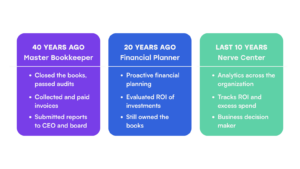
But, in the last 10 years, we’ve seen a major shift with CFOs becoming the “nerve center” of business analytics and operations. CFOs are now actively involved in analytics across the organization to understand where the business is investing, where ROI is being generated, where there is excess spend, and what business levers are available to the CEO.
This expansion of responsibilities has transformed CFOs from simply being a reporter or a planner to a business decision-maker. As a decision-maker, CFOs now have increased sway with CEOs and Boards and an increased ability to invest in their teams’ capabilities to make the best decisions possible.
Modern CFOs now position their teams as “insights-driven”, “essential-headcount”, and “value-accretive” rather than being a “cost center” to be held constant or managed down over time.
This shift means CFOs are now more involved than ever in making purchase decisions across the company and in upgrading their own software capabilities.
CFOs Are Seeing the ROI of AI in Other Orgs; They Want In
Because CFOs are the creators and keepers of the budget, they see all purchase decisions across the entire organization and are tasked with evaluating whether existing or new vendors represent a compelling use of corporate funds. While CFOs were initially skeptical of the ROI of AI-solutions for other areas of the business, the last 18 months have shown them just how powerful and compelling this wave of AI software is.
AI-native software in sales, legal, customer success, R&D, and other business functions has driven real tangible ROI and has opened the eyes of CFOs to the art of the possible for their own teams. The ROI of adopting AI is so compelling that it can no longer be put off.
CFOs now see the possibility of freeing their teams from much of the manual monotony of transaction reconciliation, invoice matching, and data cleaning to focus on all the higher-ROI projects they never quite seem to be able to get to before the next month’s financial close comes around.
CFOs are seeing AI success stories and are anxious to bring the same efficiencies to their own teams.
AI Technology Is Finally Good Enough for CFOs
While the ROI for other departments has been compelling, CFOs have been AI holdouts with doubts that LLM-driven AI would be accurate enough for their department. Having 70% or 80% accuracy in coding or customer success is a meaningful productivity boost with strong ROI. These functions also have natural error-checking mechanisms built-in (e.g., automated code review for coding and diversion to a customer success rep for customer success).
The bar for a CFO is much higher. Obtaining 70% or 80% accuracy, coupled with the black-box nature of large language models won’t cut it. In the last twelve months, the art of the possible has changed. LLM accuracy for financial use cases has risen dramatically and CFO-focused startups have launched their own small models specifically trained and tuned for finance use cases. The best startups enable deterministic (not probabilistic) AI that is easily traceable, fully auditable, and consistently reliable.
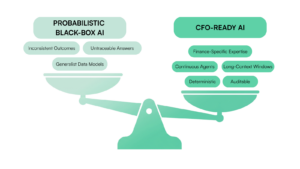
The perfect combination of auditable and deterministic AI, coupled with natural language interfaces, long-context windows, and continuously running agents, has created the tipping point for CFOs to adopt incredibly compelling AI-native software.
Early Adoption in Low-Risk, High-ROI Use Cases, but Every Category Is Being Disrupted
AI-native CFO software adoption is still nascent, but already moving quickly. The entire CFO software stack – and how finance teams spend their time – will change meaningfully over the next 3-5 years. The fastest adoption we’re seeing is in procurement, accounts receivable, and financial planning. And these categories make a lot of sense. They are highly repetitive, manually-intensive, non-bookkeeping workflows with extremely high ROI.
Additionally, a pack of well-funded startups is racing to become the core system of record for CFOs, with several already gaining promising early traction and replacing incumbent systems of record others thought would take years. The market is early, the prize is large, and we’re very excited to see these folks bring a much-needed solution to an archaic market.
Investing In the Next Generation of Founders Serving CFOs
Software for the office of the CFO has long been a large and valuable market, but the inflection point for a complete overhaul to adopt world-class software is finally here. The right timing of increased CFO responsibilities and purchasing power, coupled with the advancements in AI to allow for deterministic and auditable outcomes, means CFOs are now ready and eager to adopt this next generation of AI-native software in a way that hasn’t existed for the last forty years.
We’ve put together our view of the current office of the CFO software landscape below and are excitedly meeting with startups, CFOs, and investors in the ecosystem. We’ll be publishing additional thoughts in the coming weeks.
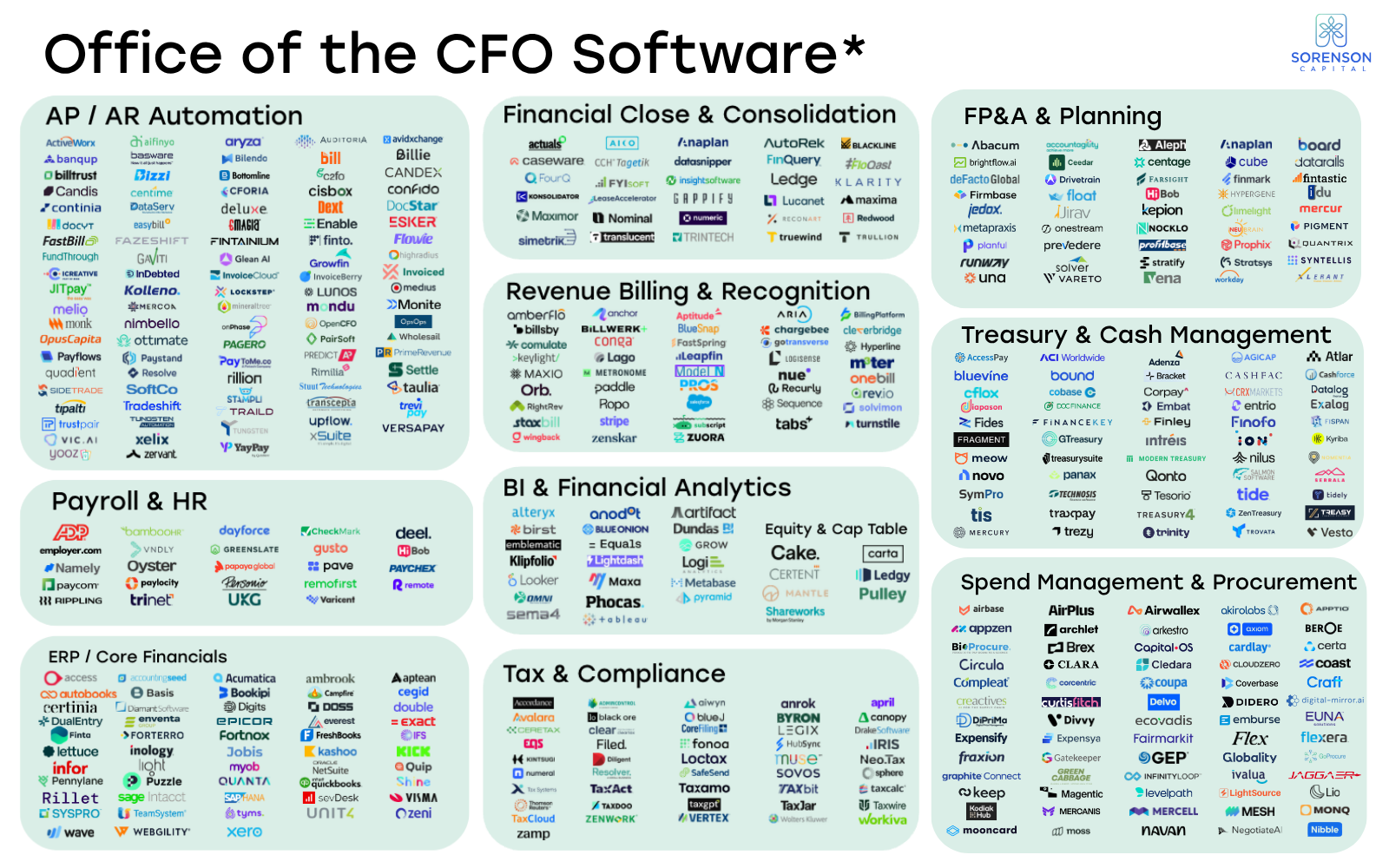
If you’re building in this ecosystem, we’d love to connect. Talk soon!
*Sorenson Capital is invested in one or more companies featured in this graphic. This does not constitute an endorsement of any company shown. A complete list of Sorenson Capital fund investments is available upon request.




 Download Article


